
Thursday, April 2, 2015

Chapter 6 - Patterning of Fabrics, again

My first attempts at shibori dyeing didn't quite take as I forgot that I was dyeing with Procion MX dye and not indigo (as I have done before). So I ended up removing my carefully stitched pieces of fabric from the dye bucket far too soon, and then watched in horror as most of the dye washed down the drain!

This is what they looked like:


Though I was mightily distressed at the time, I later realised that these pieces gave me, in fact, a nice selection of light valued fabrics which could be used later on in this module.

So I set to work stitching again, hardly a hardship since I LOVE hand stitching, and playing with shibori stitching is wonderfully soothing and relaxing. At least until you have to pull those stitches up tightly and then a little tighter - an activity which is rather hard on the fingers and best done while watching tv and drinking wine! :)


And here's a photo of my reflection taking a picture of my bucket of dye:


Here's a selection of my shibori samples:

ARASHI SHIBORI:

I loved how this turned out. In my previous unsuccessful attempts I had tried working arashi using a weighted Coke bottle, which I managed to keep submerged by holding down with the handle of the bucket! This time I wrapped the hard cardboard core of a cling film roll in layers of plastic before wrapping with a 36" wide piece of cotton, 8" long. Here's what it looked like before submerging in the dye bath:


TIE AND DYE:

These samples all worked particularly well. While the colour on the computer has rendered them more blue than black, in fact they are closer to charcoal, albeit with a blue tinge. The camera seems to have picked up n the blueness rather than the charcoal / black. One thing I did learn from all my experiments was that there are many kinds of black, and even the kind of cotton used for dyeing affects the outcome of the final colour.
These were all made using pegs, bulldog clips, rubber bands and string as resists.


TRITIK SHIBORI:

All of the following samples were stitched with nymo beading thread. I stitched straight lines, squares, zig zag lines, curved lines, and spirals. The spirals were hardest to pull tight, but were surprisingly effective. Some lines were stitched using simple straight stitch, while others were over-stitched leaving a lovely 'teeth' like effect after dyeing.


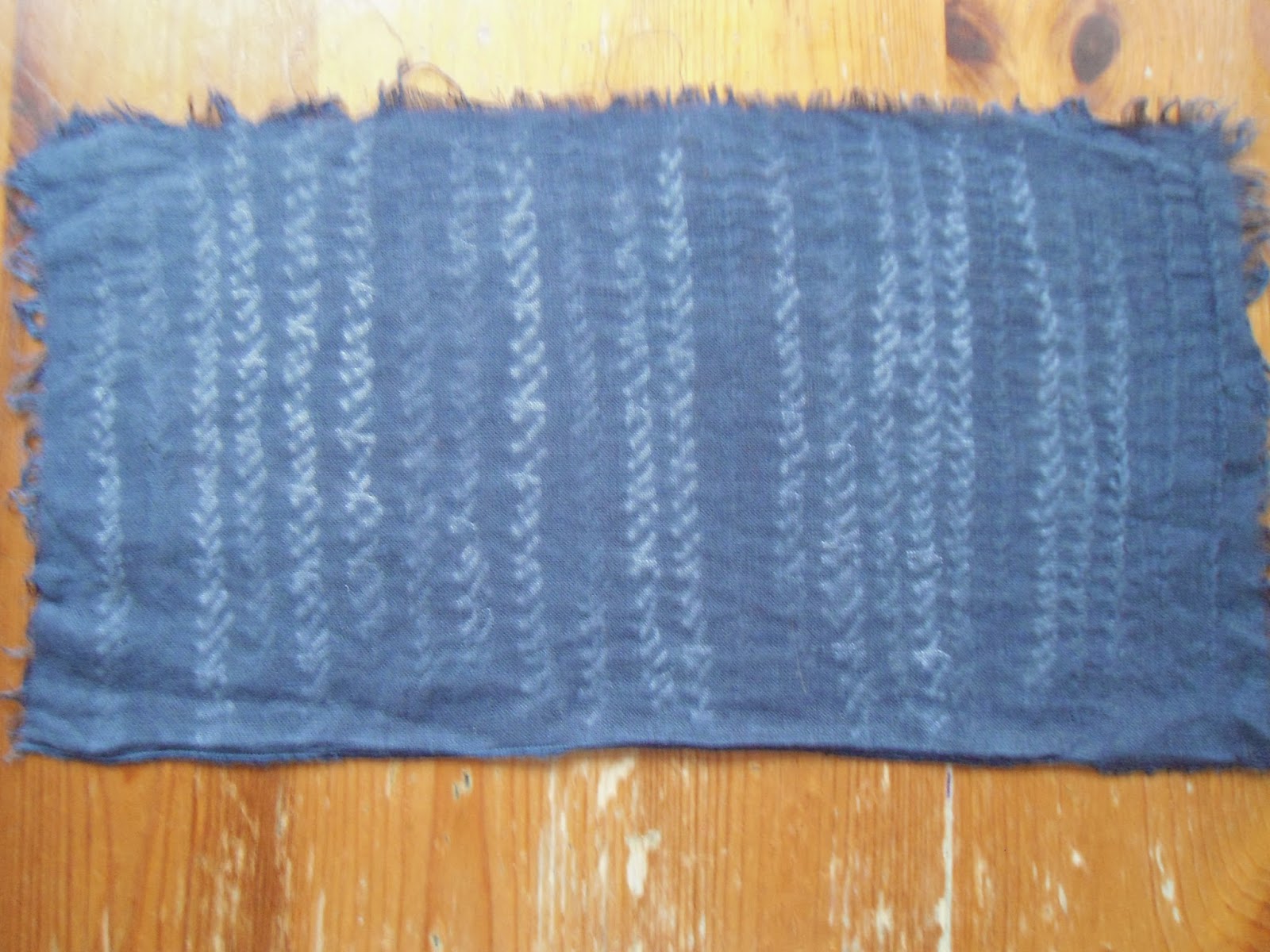


MONOPRINTS WITH BLACK FABRIC PAINT:

The following samples were worked using a variety of media, including bubblewrap, edge of cardboard and old library card, cotton buds, brayer rolled over back of page, end of cardboard tube, and corrugated cardboard. One thing I learned was that it was necessary to work fast, so the choice was to plan ahead or accept the serendipitous results!
Some of the following samples were worked on the previously 'failed' pieces of shibori.


Saturday, January 24, 2015

Chapter 6: Patterning of Fabrics using Cold Water Dyes and Fabric Paints

(1)Small collection of black and white patterned fabrics:


(2) SHIBORI METHODS USING DYES

BEFORE DYEING:

A. TRITIK SHIBORI
(i) Ori-nui Shibori (running stitched):  Running stitch vertically and horizontally to create squares on close woven cotton.


(ii) Ori-nui Shibori (running stitched): Running stitch vertically and horizontally to create small squares on closely woven cotton.


(iii) Loosely woven cotton folded accordian style, running stitch through all layers.


(iv) Loosely woven cotton, folded in four, parallel lines of zig zag running stitch worked closely together through all layers.


(v) Ori-nui Shibori (running stitched): Loosely woven cotton, folded then running stitch across fold.


(vi) Ori-nui Shibori (running stitched): Diagonal folds stitched with running stitch then small circles stitched between folds; tightly woven cotton.


(vii) Maki-nui Shibori (oversewn stitch): Loosely woven fabric folded and whip stitched over fold.

(viii) Ori-nui Shibori (running stitched): Small circles stitched on calico with running stitch.


(ix) Mokume Shibori:  Rows of running stitch worked closely together on close woven cotton.


(x) Mokume Shibori: Undulating rows of running stitch worked on fine cotton lawn.


(xi) Fine cotton lawn folded into four, then stitched with spirals and circles.


(xii) Karamatsu shibori ('larch'): Loosely woven cotton folded accordian style then running stitch worked in parallel curves.


(xiii) Ori-nui Shibori (running stitched): Loosely woven cotton folded horizontally and vertically to create squares, running stitch worked on folds.


(xiv) Spiral worked in running stitch on fine cotton lawn.

 (xv) Loosely woven cotton folded in four, then stitched with parallel lines of running stitch.

(xvi) Maki-nui Shibori (oversewn stitch): Loosely woven cotton folded horizontally and vertically to create squares, whip stitched over folds; 2 digonal lines in centre of each square, also folded and whip stitched.

 (xvii) Loosely woven fabric folded accordian style, 3 step hand stitched zig zag.

(xviii) Maki-age Shibori (stitched and tied resist)::Cotton calico, unbleached, stitched with running stitch vertically and horizontally to create squares, then small circles stitched in centre of each square, hen centre of circle tied.


B. TIED-RESIST SHIBORI:

(xix) Unbleached cotton calico scrunched into a ball and wrapped with elastic bands.

 (xx) Unbleached cotton calico, rolled around length of strong wool, then tied in a knot pulling gathers tightly.
 (xxi) Unbleached cotton calico, gathered and tied with elastic bands.
(xxii) Ne-maki Shibori: Unbleached cotton calico, fabric pinched and then wrapped and knotted with strong thread before carrying thread over to next section.


C. ITAJIME SHIBORI - FOLDED AND CLAMPED SHIBORI:

(xxiii) Unbleached cotton calico, folded accordian style before clamping with clothes pegs.


D. ARASHI SHIBORI:

(xxiv) Loosely woven cotton stitched on to plastic bottle then bound and scrunched up.